
Comparison of Dialogue and Debate
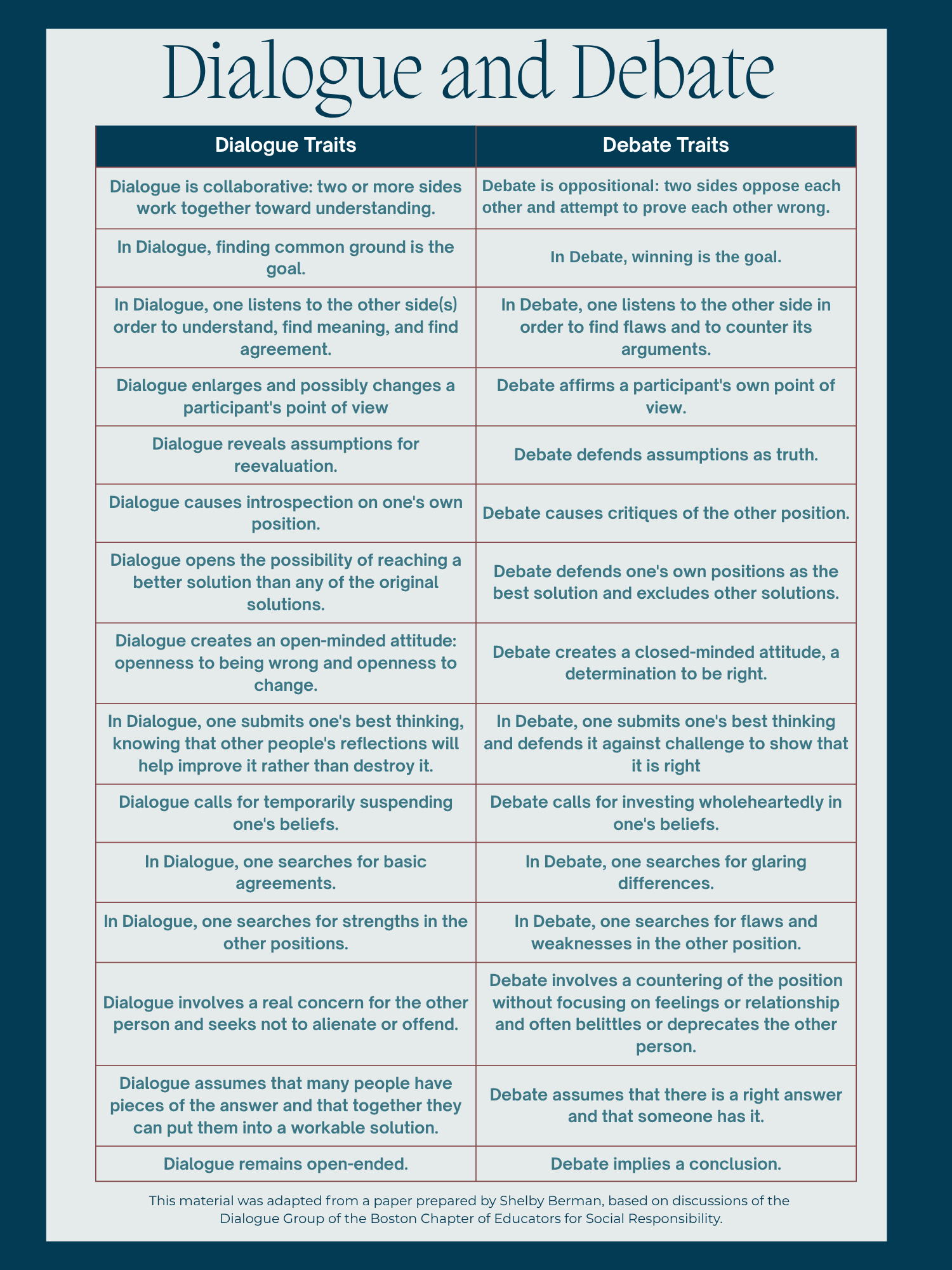
This comparison of Dialogue and Debate was created by the Study Circles Resource Center, now known as Everyday Democracy. This material was adapted from a paper prepared by Shelby Berman, based on discussions of the Dialogue Group of the Boston Chapter of Educators for Social Responsibility. The organization helps all kinds of people engage in dialogue and problem-solving on critical social and political issues. For more information, go to everyday-democracy.org.
Listen Up
NPR's Michel Martin speaks with author Tracie McMillan, whose journalistic memoir — The White Bonus — examines the cash value of institutional racism in the United States.
Understanding Institutional Racism: Easy-to-Read Summary
Main idea: Institutional racism happens when organizations, systems, rules, and everyday practices create unfair outcomes for people of color. It is not only about individual prejudice. It is also about power — who controls institutions and who is harmed by their decisions.
What Are Institutions?
Institutions are organized parts of society. Examples include governments, schools, businesses, banks, police departments, hospitals, media organizations, churches, and community groups. These institutions shape daily life because they make decisions about education, housing, jobs, safety, money, and public services.
Racism Is More Than Personal Prejudice
The article explains that racism is not just negative opinions or individual acts of bias. Racism becomes especially harmful when prejudice is supported by institutional power. When institutions make unfair rules or follow unfair practices, those decisions can affect whole communities.
Direct and Indirect Institutional Racism
Direct institutional racism is open, intentional discrimination. Examples include laws or policies that openly separate or exclude people by race.
Indirect institutional racism is harder to see. It may be intentional or unintentional, but it still produces unequal results. Examples include housing steering, redlining, unfair hiring requirements, school inequality, or political boundary changes that reduce representation.
Why History Matters
The article says today’s racial inequalities are connected to past laws and decisions, including slavery, segregation, and other systems that controlled and excluded people of color. Even after many openly racist laws were removed, the effects remained in housing, education, jobs, banking, policing, and politics.
Five Levels Where Racism Can Exist in Institutions
Personnel: The attitudes and actions of individual employees, such as a racist teacher, police officer, judge, or salesperson.
Policies: Written or unwritten rules that may create racial inequality, such as unfair hiring requirements.
Practices: What institutions actually do, even if their official policy sounds fair.
Structures: How an institution is organized, who has authority, who is represented, and who receives services.
Foundations: The deeper purposes, traditions, beliefs, history, and financial support that shape the institution.
Key Examples
Housing: Communities became segregated because of deliberate institutional decisions, not by accident.
Banking: Redlining and unequal mortgage lending made it harder for people of color to buy homes or build wealth.
Education: Schools in communities of color often received fewer resources because of decisions made by school boards and public officials.
Employment: Hiring standards can exclude people of color when they ignore the unequal opportunities created by past discrimination.
Politics: Gerrymandering can weaken the voting power and representation of communities of color.
What the Article Says Must Change
The authors argue that institutions cannot fix racism only by changing individual attitudes. Training staff may help, but deeper change must also address policies, practices, structures, and foundations. Institutions must examine results, not just intentions. If outcomes remain unequal, racism may still be operating.
How Change Should Happen
The article emphasizes that people who control institutions should not assume they can solve institutional racism alone. Real change requires broad coalitions and leadership from people of color, because they often understand the effects of racism most clearly and can help identify what needs to change.
Bottom Line
Institutional racism is built into systems, not just individuals. It can be obvious or hidden, intentional or unintentional. To dismantle it, institutions must look honestly at their rules, behaviors, structures, and history. The authors believe racially just institutions can be built, but only through deep, long-term change.
White People Facing Race Summary
Original article: “White People Facing Race: Uncovering the Myths That Keep Racism in Place” by Peggy McIntosh, Ph.D.
Peggy McIntosh explains why many white people find it difficult to talk honestly about race and racism. She argues that this resistance often comes from fear, discomfort, and cultural myths that protect white privilege. The article encourages white people to face race with honesty, humility, and a willingness to learn, rather than with blame, shame, or guilt.
Why Talking About Race Can Feel Difficult
In workshops, McIntosh asks participants to finish the sentence, “A hard or scary thing about talking about racism is...” White participants often say they fear being called racist, saying the wrong thing, being blamed, feeling ashamed, hurting someone, or discovering uncomfortable truths about themselves.
McIntosh says these fears are connected to the desire to see ourselves as good people. For white people, facing racism may challenge a positive self-image and raise difficult questions about history, privilege, and responsibility.
The Five Myths That Keep Racism in Place
McIntosh identifies five cultural myths that can make it harder for white people to recognize racism and white privilege:
Meritocracy: The belief that everyone gets what they earn and deserve, without considering how systems can give some people advantages and others disadvantages.
Manifest destiny: The belief that white settlement of the United States was natural or divinely intended, which hides the harm done to Indigenous people and others.
White racelessness: The belief that white people are “normal” and do not have a race, while only people of color are seen as racialized.
Monoculture: The belief that there is one American culture that everyone experiences the same way, and that people of color should simply assimilate into it.
White moral elevation: The hidden belief that white people are more fit to lead, govern, or define what is normal and valuable.
How Schools and Media Reinforce Resistance
McIntosh argues that schools often teach a simplified, positive version of U.S. history that makes white Americans feel normal, good, and deserving. This can discourage students from seeing larger systems of privilege and oppression.
She also says the media often focuses on individual stories instead of connecting them to larger systems. Because of this, racism is treated as a personal issue rather than a structural one.
Why Institutions Resist Change
Organizations and institutions can resist facing race just like individuals do. They may fear losing power, money, status, reputation, or control if they examine their histories and address past or present inequities.
McIntosh notes that some corporations and universities have begun diversity work, but often for practical reasons, such as improving reputation or business success. She believes deeper change requires understanding privilege, oppression, and systems of power.
How to Move Past Resistance
McIntosh says people can overcome resistance by learning to see beyond individual experiences and recognize the systems that shape people’s lives. This means understanding that birth, culture, language, race, gender, and social position affect opportunities and perspectives.
She encourages people to develop the ability to recognize both oppression and unearned advantage. The goal is not to create guilt, but to reduce harm and increase the common good.
The Power of Honest Conversation
McIntosh believes that honest group conversations are one of the best ways to reduce fear and defensiveness. When people tell their stories and listen respectfully to others, they can better understand race, privilege, and their own role in systems of inequality.
These conversations can bring relief, empathy, connection, and hope. Instead of destroying self-esteem, facing race can help people understand themselves and others more clearly.
Key Takeaways
Many white people avoid talking about race because they fear blame, shame, conflict, or losing a positive self-image.
Five cultural myths help protect white privilege: meritocracy, manifest destiny, white racelessness, monoculture, and white moral elevation.
Schools and media often reinforce these myths by focusing on individuals rather than systems.
Institutions may resist racial change because they fear losing power or status.
Facing race requires learning to see both oppression and privilege as parts of larger systems.
Honest, respectful conversation can reduce fear and help people take responsibility without being trapped in guilt.
The Bottom Line
The article’s message is that racism is not only about individual prejudice; it is also about systems, history, and privilege. White people can help weaken racism by facing these realities honestly, listening to others’ experiences, and using their awareness to act more responsibly and compassionately.